Bright Slide is making educational applications for the iPhone that help parents connect with their children, follow their learning and take a more active hand in it. We think that’s a fantastic idea and so we sat down to chat with Brian Casazza to talk about Bright Slide, their goals and using games as teaching tools. Our review score for their first iPhone app (8 Planets) was a whopping 9.5 giving it a GDN Gold Award and putting it in elite company.
[GDN] How did Bright Slide first see the iPhone as an educational tool?
The founders of BrightSlide are successful mobile media entrepreneurs, technology evangelists, educators and gamers, but first and foremost we are parents. We took notice of the iphone, and like touchscreen devices, as a profound educational platform when we witnessed the ease with which our kids (2 - 6) were able to manipulate its user interface. Once we started looking into it, we discovered that the touchscreen platform is really the most intuitive learning interface for children under 12 years of age. Over the next couple of years with the growth in the iPhone OS, Android, Windows and many other touch devices will we find these amazing educational devices in everyone’s pocket. We think that represents a great platform to turn idle moments into educational opportunities.
[GDN] Can you tell us the basics on 8 Planets please?
8 Planets is a collection of 4 educational games designed to build on one another and develop a framework of knowledge around the 8 planets in our solar system. Children start by learning the names of the planets and some key facts. They then progress to putting them in their proper order, spelling their names in their entirety, working through matching games and finally culminating with a game we call the Black Hole. Black Hole is a game where planets must be rescued by utilizing the knowledge you have developed before the Black Hole sucks them up.
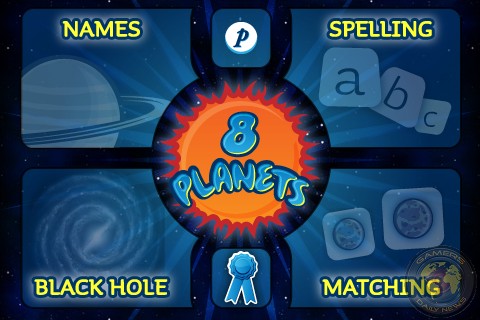 It is designed for children 3 - 8, but we find that it also works well for toddlers and parents who want to brush up on any basic planetary knowledge they may have forgotten. By incorporating learning exercises into gameplay (identification, spelling, matching, ordering, etc.) we have developed a very engaging learning environment where kids have fun. More often than not, they don’t even realize they are learning. It is play and education at the same time. You can get all 4 games in one package for $2.99. It’s an amazing time to be a consumer in digital media. You can buy a high quality video game for $2.99!
[GDN] How is 8 Planets different from other educational games?
8 Planets is different from other educational games in that its focus is not only on developing a framework of knowledge around a subject, but also helping parents build an understanding of how their children learn. We accomplish that through report cards that surface data about your child’s interaction with the game. We plan to allow parents to associate all of our future applications across a variety of subjects with their children’s report cards. This will give them great insight into how their learn, where they are strong, where they may need some more focus.
Too often parents purchase video games for their children and the dialogue stops there. We want our video games to be something that connects parents with their children, not divide them. This will become increasingly important as kids learn in more interactive ways.
[GDN] What kind of reports can the parent receive in regards to how their child is learning?
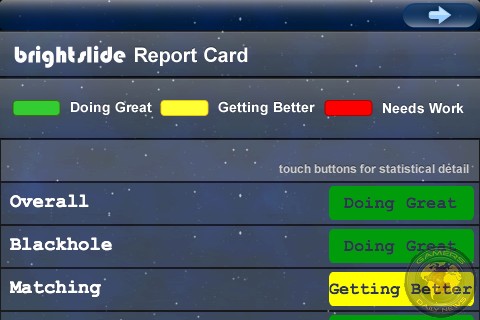 Right now, the report card gives you information about your child’s patterns in various general categories such as accuracy and speed. We can also tell you how your child performs when presented with challenges based on pictures, letters and numbers. There are also categories specific to 8 Planets like spelling, matching, and black hole. At a high level, the report card tells you whether they are "doing great", "getting better" or "needs work" which is based on how you compare to the overall group of players. You can touch the category fields to get more detailed data such as percentage correct and time to correct answer.
We are continuing to work on upgrading the features of the report cards and will be adding more information to the reports soon.
[GDN] What potential do you see for video games as learning tools?
We think that video games present enormous potential as learning tools and that we are really just scratching the surface. We know now that learning happens everywhere and that standard skills are becoming less important. What children need to learn to be successful in a technology based future is how to innovate. How to leverage standard skills, computers and their networks to be successful in a given vocation. Computer games are an excellent platform to accomplish that, not only because they are appealing to kids, but because they can present simulations so effectively. You can create a video game that is engaging and fun that simulates being a lawyer where the objective is to win cases. That requires you to do research, to build a case and ultimately you learn what it means to be a lawyer on a daily basis.


